The world is full of amazing creatures and when it comes to the order Coleoptera (Beetles) their number and diversity are astounding!
~ HINT ~
Underlined portions in today’s post will take you to more, and interesting information!
We all know the Ladybug as an old favorite of childhood. We sang little poems about them, played with them, collected them in critter cages, and, sorry to say it, often loved them to death… Poor Ladybugs.
Recently, I read about a woman who uses Beetles as art expression and room decoration. She does it by creating a three-dimensional “wallpaper” for her clients. Honestly, from the distance the work looks lovely.

Click either image to be taken to Fiberarts Magazine, and the photo’s source
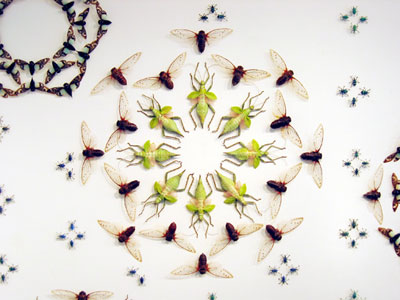
I keep imagining that they might get a bit ‘gamey’ in hot and/or humid weather. Hm…
Yesterday, Bob came in all excited about a giant beetle he found outside.
“Its huge and has giant pincers!” he said.
I confess, that I never did grow out of my bug loving phase from childhood, and so I made him take me to go and see it.
He was a handsome specimen too! One and a half inches of burnished mahogany from the tip of its pincers to the anterior of its wing casings. Carefully picking it up for a closer look, I then marveled at its ferocity and strength! I took him inside and placed him into the bottom of a plastic container.
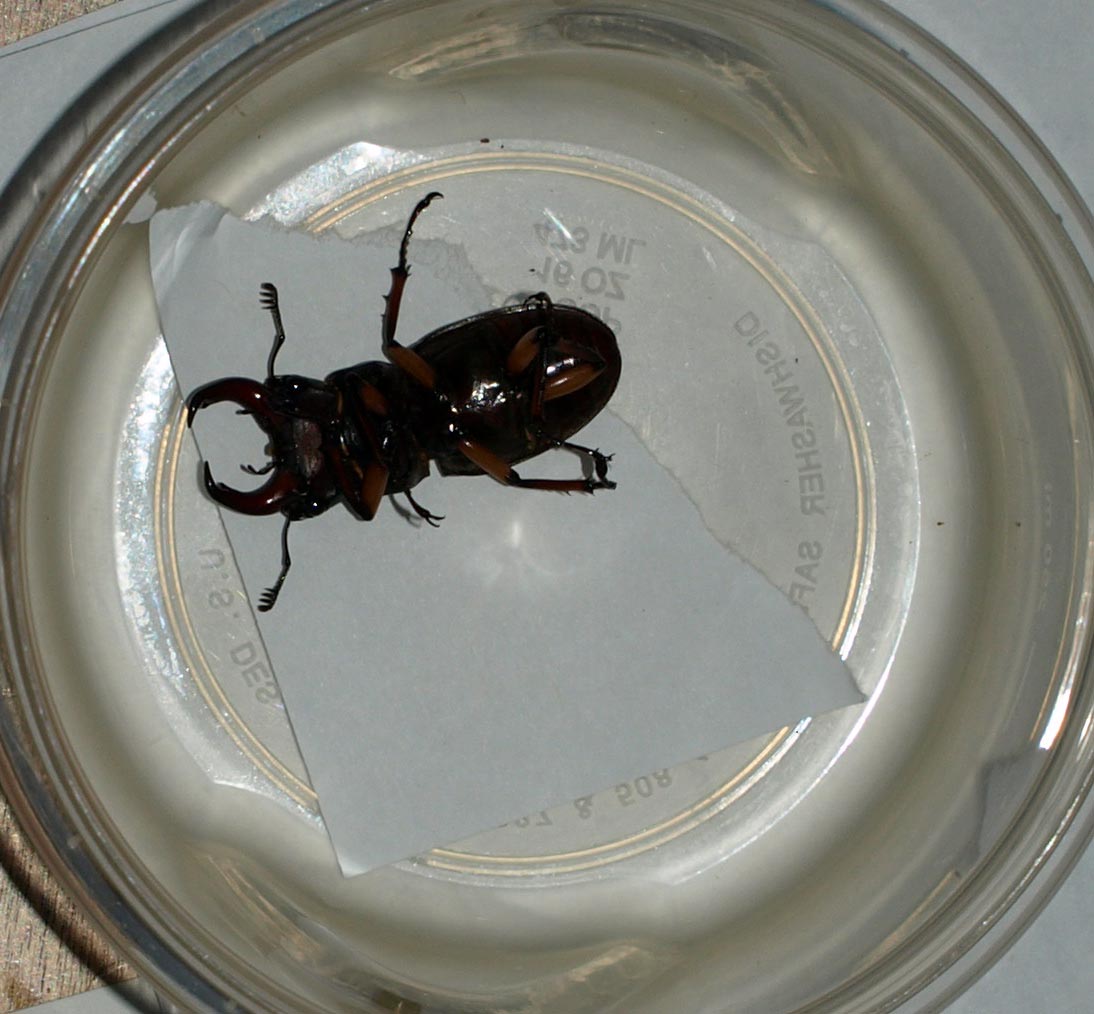
He landed on his back and couldn’t move. I made several attempts to assist, but the container was too slippery, and onto his back he’d return.
He was definitely out of his element, and for all his strength those grappling hooks on his legs couldn’t find a foothold to help him upright. Instead, they were getting hooked onto his legs and binding them to himself!
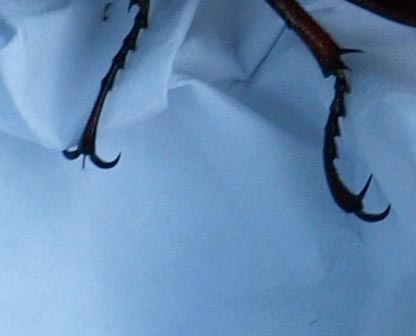
I crumpled some paper and put him onto that. Success!
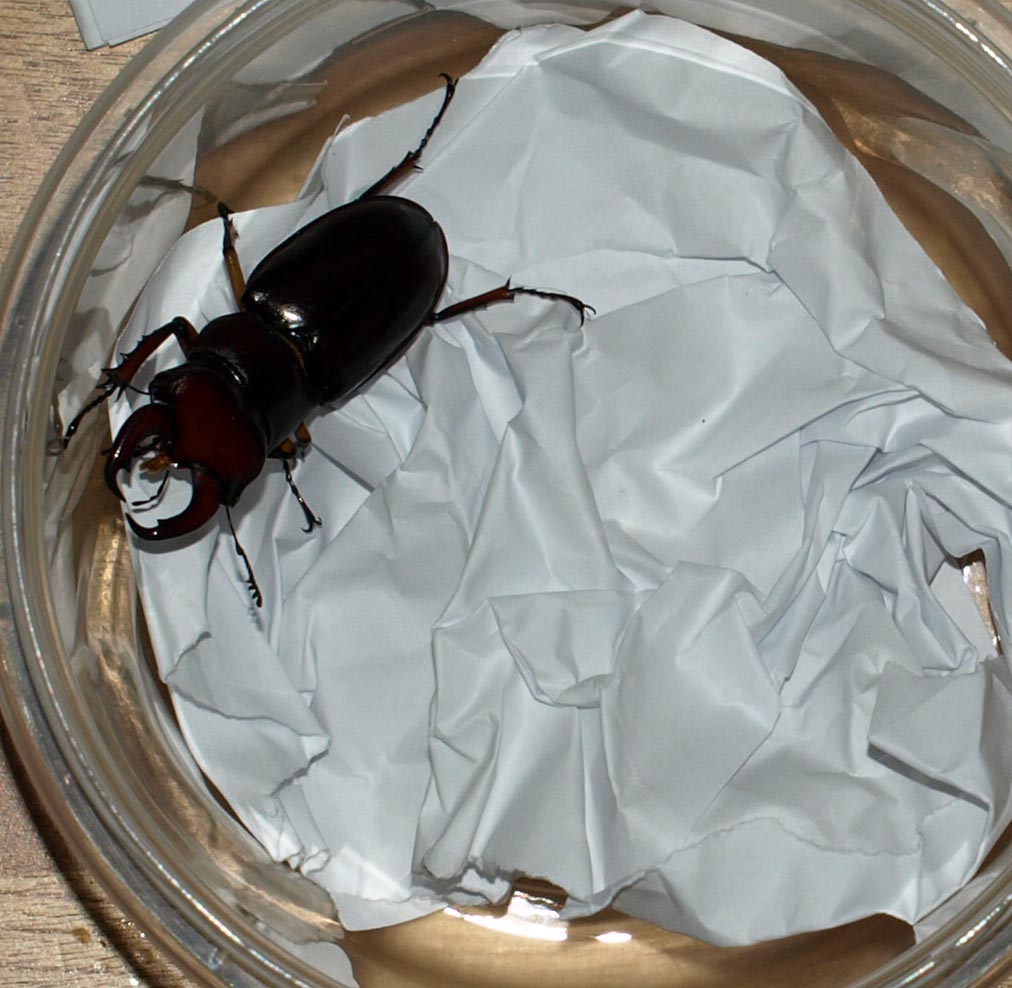
Watching him crawl around in circles became disheartening, so I took him outside and set him free.
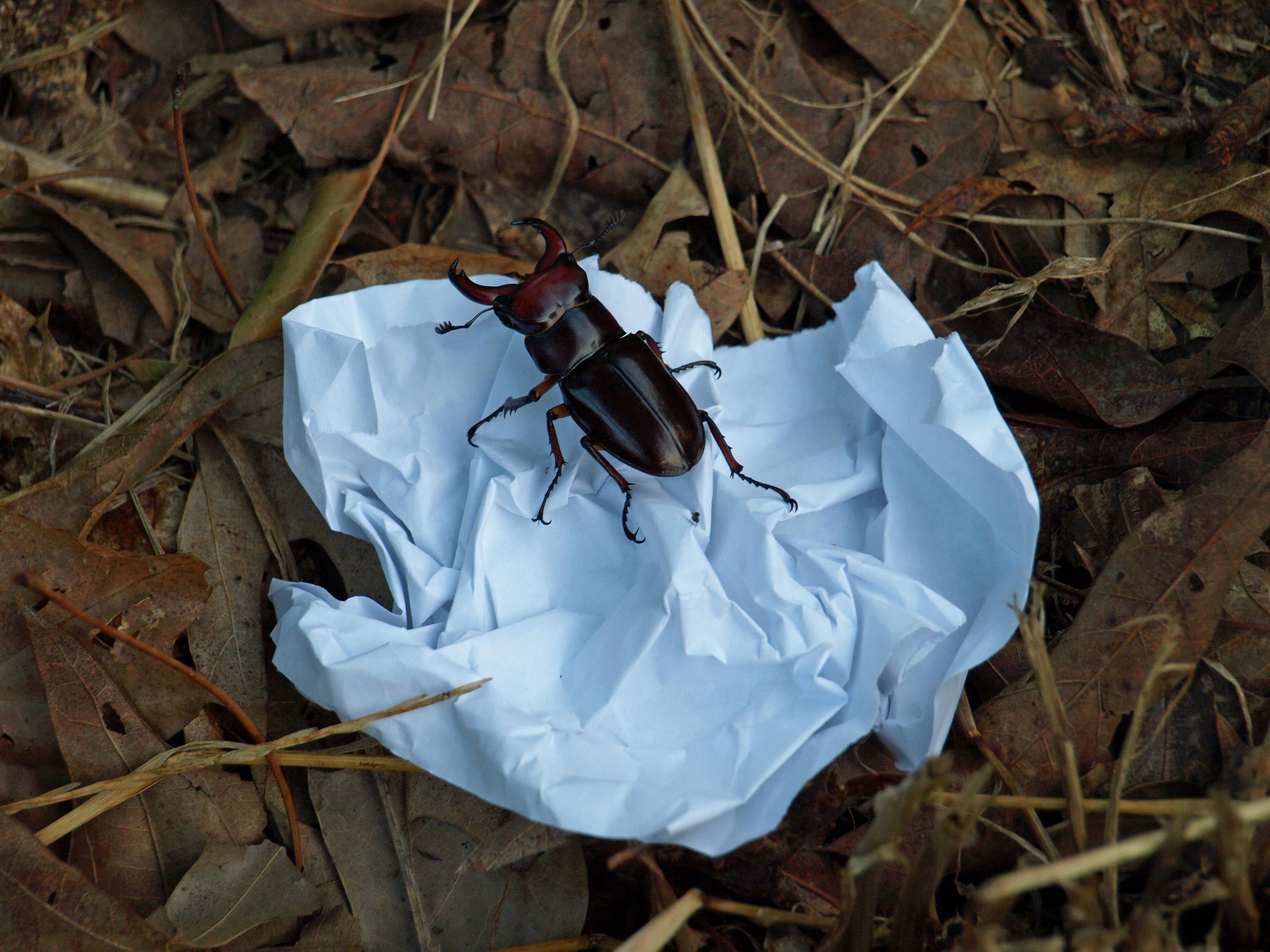 I think he is beautiful.
The sudden movement caused him to take a defensive stance. I tried to move him off of the paper and onto the leaves, but he would not budge. I picked him up and carefully removed the paper from his grip…
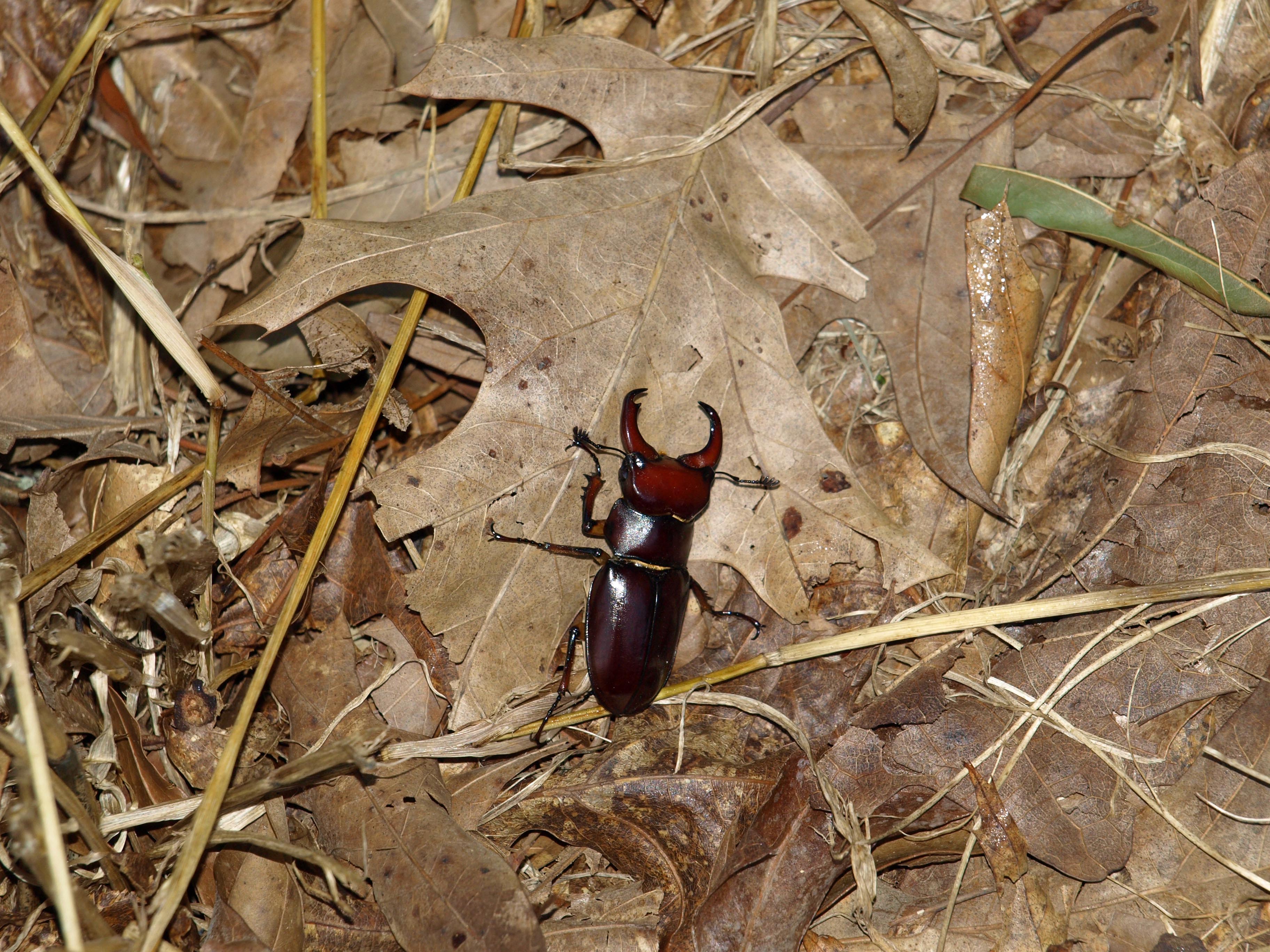
At which point he grappled himself, again, and just lay there. I left him to sort it out and went online to find out more about my visitor.
~ NOTES ~
He is a Stag beetle, Lucanus elaphus to be exact, and can be identified as a male by his larger pincers. He uses them for establishing dominance (competing with other males), and taking a fierce stance to ward off predators. They can pinch, but are not harmful. The females have pincers as well, but they are much smaller by comparison.
The largest Stag beetle is about 11.938 centimeters (4.7 inches) while the smallest Stag beetle comes in at about 1 centimeter (or 0.39 inches)
Stag beetles are forest recyclers. They lay their eggs on decaying wood and the larva help to return it to the forest floor. The grubs, depending on the variety, can remain in the wood for up to seven years, however the beetle itself is short-lived at only one to two years. The grubs for this variety take only one year to develop from grub to beetle.
In England, the Stag beetle is considered an endangered species. Due to the loss of the beetle’s natural habitat, they have begun placing rotting logs in parks and backyards to help them regain their numbers.
~ MY THOUGHTS ~
We often find creatures in our environment that can look alarming to us, however, each animal or creeping thing on this earth has a niche to fill, and a job to perform. Many such creatures are maligned and destroyed simply out of fear or ignorance. I encourage you to find out more about what scares you in the wild of your own back yard. For I am certain that you will be amazed at the jobs they perform, and at their efficiency in the performance of their jobs.
 Life on the Farmlet