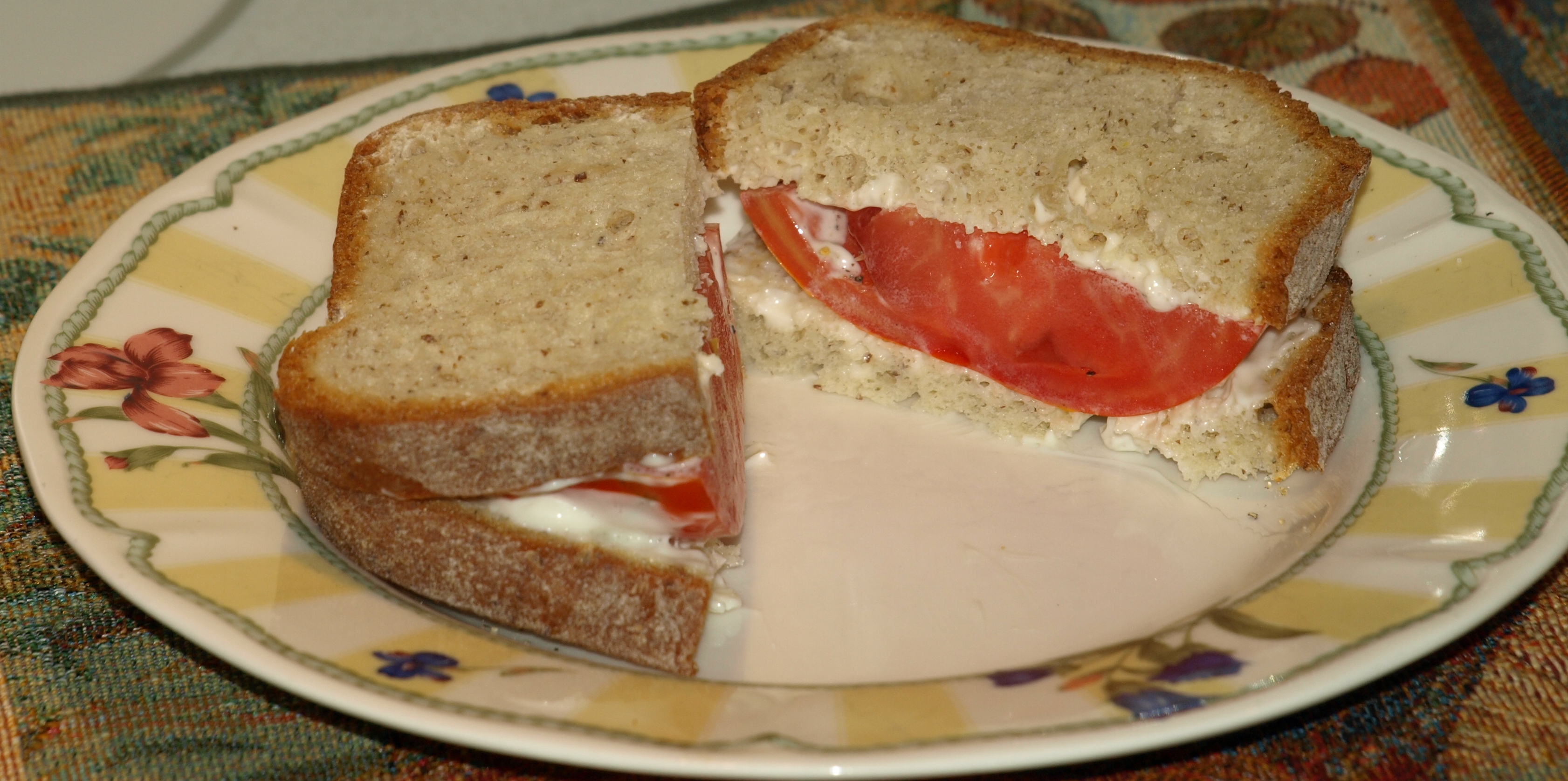
Kitchen Sink Tomato Sandwich: gluten free style

Cover of "White Trash Cooking (Jargon)"

Cover of White Trash Cooking (Jargon)

It’s time for The Ritual of the First Tomato of the Season.   However, let me say right up front that this is not mine!  Oh no!  I comes from a little gem of a cookbook called White Trash Cooking by Ernest M. Mickler  (the recipe is to be found on page 74).

If you haven’t read White Trash Cooking, well then I know you haven’t discovered the delights of deep south white trash cookin’!

The recipe is simple enough, but I will tell you the authors version is more authentic and infinitely more entertaining!

Kitchen Sink Tomato Sandwich:  (my version)

Ingredients:

~ 1 very ripe, fresh picked, still warm from the vine tomato sliced THICK (book says refrigerated, but I like mine warm)

~ 2 Slices of Udi’s whole grain Gluten Free Bread (or your favorite)

~ Enough Mayonnaise to slather onto both pieces of your bread

~ Salt and pepper to taste

Method:

Put the mayo onto your bread, add the tomato, salt and pepper, put the other slice on and press it down real good.  Grab it with both hands and eat it over the sink.

Why over the sink you ask?  Well, you don’t want to be wearing all that juice on your clothes do you?  I’m sure that the book references something about “…rolling up your sleeves and letting the juice run down your elbows into the sink.”

This is so simple.   If you haven’t had one, well, then I’m certain you will not believe how really good it tastes!

ENJOY!

NOTE:  Other versions online use Wonder bread and Miracle Whip, but I leave those details to your personal taste.  😉  Oh, and do follow the link for Miracle Whip… I had no idea about its history.  An interesting read!

***  This is NOT a paid endorsement, though I wish it were, I just happen to love this cook book! *** 

Lady Spider: the flip side

This morning I ventured out while the air was cool.  The heat and humidity have been so oppressive that it was a shock to open the door and feel a delicious breeze to greet me.

I set to work pulling grass and other weeds to throw over to Polly and the gang.  They come running, honking thanks, to chow down.  Though they carefully remove the spurge.  (I think they don’t like its milky sap.)

I worked my way down the row of tomatoes and there she was!  My Lady Spider from last week’s post… Posing in perfect lighting!  I ran for my camera, and quickly washing the grime from my hands, I dried, then ran back out again.

I caught her.

Is a leftover leg from your previous meal as embarrassing as having spinach in your teeth on a date?

Then as I watched a rather large insect flew by and was caught in her web.  Faster than I could respond, she was there, but I was able to get a few shots of what transpired next!

Quickly she began to twirl the insect with her legs, all the while coating it with a jet of silk shot from her spinnerets.

Now as I watched she stopped for a moment and…

inflicted her victim with a venomous bite.

I continued watching as she cut her prey loose and in a flash ran back to the center of her web…

where she will dine at her leisure.

End note:

Spiders, lacking teeth, must dine on a liquid diet.  Using specialized mouth parts called chelicerae they inject poison into their victims.  The poison paralyzes their meal, but does not kill.

The world of spiders may chill you gentle reader, but without them we would be awash in insect pests of all sorts and descriptions!  I find their world fascinating, yet repulsive.   However, the thought of the alternative finds me giving the ladies my blessings to hunt the gardens here.

BECAUSE YOU ASKED:

The center zigzag pattern of the orb weaver‘s web is called the stabilimentum, and although it has been named, it is up in the air as to the function it serves.  Some say camouflage for the spider, others say to keep birds from flying through it (or unwary gardeners walking into it!) Still others claim it attracts insects into the web.  Whatever its use to the spider it is surely of varied and interesting construction!  Please do follow the link, via a click on the word above, to see some of these variations.  For those of a more scientific mind, please look on the web page Psyche A Journal of Entomology which can be found here:  http://psyche.entclub.org/87/87-013.html

Photo Friday: here and there, then and now

When we first moved here I was so exited about how green and lush everything is.  I was also excited to have so much room to plant in and couldn’t wait to get started.  HA!  The first time I tried to put the garden fork into the soil it bounced back and almost knocked me out!  We tried to use the Mantis to till out a garden spot and it just bounced along on the surface while the weeds and grass laughed at our folly…  So we went out and bought a BIG BOY Cub Cadet garden tiller.

I am afraid to use it. 

It is a seriously big and powerful machine.  When cranked up it sounds like a tractor and puffs huge blasts of air out of the front exhaust.  It reminds me of a bull getting ready to charge… I envision that the mighty beast will knock me to the ground,  sit on me, all the while huffing and snorting in victorious laughter.

If you like this and need one, you can click the picture to be taken to their site… (and NO, I am not being sponsored nor receiving any monetary compensation for this.)

For this reason Bob preps the areas I want to garden with the Cadet, and then I come in with the little Mantis to wage war on all the weeds.

Sometimes I get frustrated by the way, seemingly overnight,  the weeds come and take over my garden.  I think about my gardens in California and I get melancholy…  seems that with less water there was more control.  However, there was a cost too.    Water restrictions and the expense of watering the portions of the garden that needed it (my herbs and roses) made the price of gardening high!  Water rates were hiked 40% over a span of 4 years!!!  Hence we hired someone to design a native garden for us.  One that could live off of the average rainfall in Southern California.  We, of course, did all the work to save money!

It looked like this before…

Needless to say, this is not practical in an area that was desert before it was irrigated and overpopulated!

Enter Brian Swope from Tierra Seca Landscape Design who did some wonderful planning for us.    So, when we got done planting the yard looked like this!

Once established we never had to water it!  There are more pictures HERE

By the way, you can see more of his finished projects HERE!  He has since moved to the vicinity of San Francisco, if you live up there I strongly urge you to contact him.  You will not be disappointed!

~*~

And so it is, bit by bit, I have been trying to work a miracle.  Trying to turn all the weeds and wild grasses into gardens.  It is a slow and labor intensive process with nearly 6 times the area to cover.  Seems I start at one end, turn around to look back and…

More weeds!

Sigh.  I look for the day when the weeds have given up and the gardens have taken over.

In the meantime, I pick away at it…

Weeds and grass out!  Some new plantings in.

From back to front:  the sunflowers, tomatoes, peppers are done, but the bush beans are still waiting!

A neighbor came by and bulldozed the giant, grass-covered, red clay mountain behind the vegetable patch for us early this morning (red area in photo above)!  Now we will begin the process of sheet mulching to make it healthy, plantable soil!

With the exception of the rock drive, I have stuck to my plan of no chemical agents (Roundup).  I wonder if I will I ever gain control.

How do you conquer your garden nemeses?

NOTE:  Strictly speaking, if you sheet mulch you should not be rototilling.  However, with our hard-packed, concrete, red clay soil we feel the need to get things softened up before we turn 90.  Hence, we sheet mulched for two years, then rototilled, then planted.  The soil is now very friable, allows better drainage, and good deep root structure on the plants.  Over the winter months, we will sheet mulch again and then, hopefully, we will not need the rototill in the areas that have been worked over the three-year improvement time!
* “But… it’s only a little bunny!”

Tonight while putting the chickens away I saw Little Bit chasing after something…

It was a little rabbit about 5 or 6 inches long and she nearly got it until Bob stepped in.  I walked over to where Bob was pointing at the base of the tree and there it was, with its little head stuck into the crotch of the tree’s roots.  Gently I reached down and scooped it up.  Immediately it started wriggling in my hands and I held on just a bit tighter.

So furry and soft with little ears that framed its face.  I looked into its eyes and saw fear.  I’m sorry little one.

Nearing the fence I was just about to bend down and push it back through, when it began to scream!  Apparently it could no longer contain its fear.  How can such a little creature make such a big scream?

Surprised, Bob asked, “Did he make that noise?”

“Yup,” I answered.

The look of surprise on his face was priceless!

I wondered why it’d come into the yard.  They hadn’t done it before.  Then it hit me!  It was the horses.  They have eaten everything but the honeysuckle vine out back… there is not even one clover, nor one blade of grass for even the littlest of bunnies to eat.

If I have identified him correctly he’s a baby Sylvilagus floridanus or Eastern Cotton Tail Rabbit.  Glad I saved him from the cat!

(Picture is borrowed today, click photo to follow link to owner!)

I hope he makes it!

Warning,  The following is a bit alarming if you aren’t prepared for it!

Didn’t think a bunny makes a sound?   Well, click   HERE  and listen to how the little guy can sound his displeasure! 

*(The title is a quote taken from Monty Python and the Holy Grail)