First let me demystify the Winged part of Winged Sumac.
Winged Sumac gets its name from the “wings” that grow along the shaft of its composite leaf.
Here in the closeup is one composite leaf. For those who may not know, a composite leaf is made up of several leaflets attached to a central stem. In this young specimen the stem is attached to the main stalk of the plant.
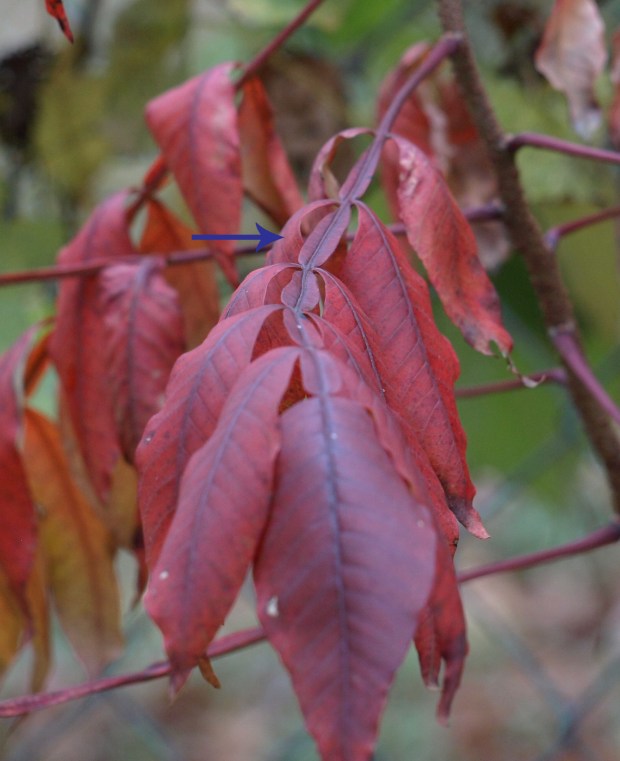
Notice the growth along the shaft? Those are its wings! 😉
~*~
Now for a few more photos of Autumn before it is all gone for 2012

This was taken at the end of the day with an overcast sky.
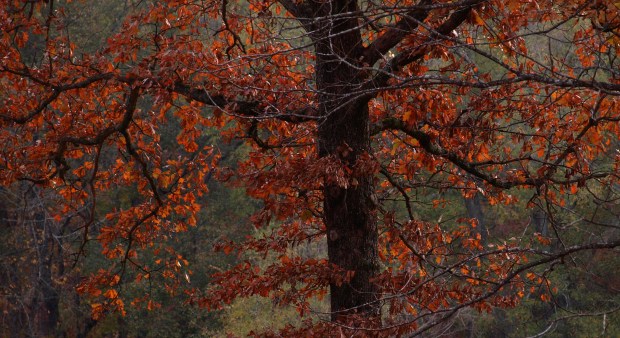
So beautiful!
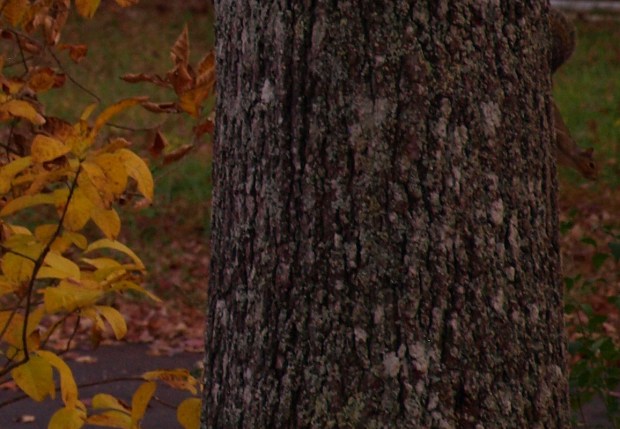 Squirrel!
~*~
Note: Want to know more about Sumac? Then check out these informative sites!
How we can utilize the plant…
- Eat the Weeds at http://www.eattheweeds.com/sumac-more-than-just-native-lemonade/
- First Ways at http://firstways.com/2011/08/23/how-and-why-to-eat-sumac/
And how nature and wildlife utilize use the plant…
- USDA fact sheet at http://plants.usda.gov/factsheet/pdf/fs_rhco.pdf
Related articles
- What makes leaves change color in the fall? (cntnews.wordpress.com)
- Fattoush (acedarspoon.com)
 Life on the Farmlet
that sumac is pretty cool, I have not seen hat one around here, you have beautiful fall colour,, those trees are glorious.. c
Thanks Celi, it was the trees and the views we have from our house that made me choose it. Except for some parts of winter, it is always a show!
What beautiful photos! Sumac is very widely used in Turkish cooking, but I have never seen it growing up close. Thanks for clearing that up.
I had always wondered what that mystery ingredient was and where to find it… I never realized it was growing in every ditch-bank around me for miles! I am excited to harvest the seeds next year and grind them for cooking. 😉
Autumn is a great time of year. Lovely pictures.
Yes it is, Tom, and thank you!
Nice color variety. Thanks for sharing!
Thanks, Patti! Coming from dry and hot Southern California I am amazed every fall at all the colors around me. LOL, and every year I think it is better and brighter than the previous season. I am sure that is not so, but the novelty of it all excites me every time!
I’m glad to see you’re flying high with winged sumac, which looks pretty similar to the prairie flameleaf sumac (Rhus lanceolata) that we have in central Texas. Except for a few stray leaflets, ours are still weeks away from putting on their show, one that I’ve come to look forward to near the end of each year in a region not rich in large-scale autumn color.
Yes, the sumac does have brilliant color! I had mentioned wanting sumac in my garden a couple of times on your site, and so was delighted when it volunteered along the back fence this year. While we don’t share all the same lovely plants that you have in Texas, I am nonetheless excited when your hard work helps me to ID the plants in the wild here in Alabama. Thanks, Steve!
You’re surely welcome. One thing I found after I learned some basic identification in central Texas was that when I traveled to other regions I could sometimes at least recognize the family or genus of plants there that were unknown to me.
Well, between you and the USDA plants database I hope to gain similar skill in plant ID. 🙂
Ahh, that’s what winged means in this case. They’re very pretty.
I think so too, Annie! The tricky name does make sense once you know the secret. 😉
Beautiful colours of autumn !
Claire, each day, so far, I have imagined that they couldn’t get any better, and yet the do! The winds came and decimated the first to turn, but then each week something new contributed to the beauty around me. There are still things that are turning, but not done yet! Amazingly, even my blueberries are turning scarlet. They are the very slowest so far.
the info about the blueberries gives me a real comparison, mine lost their leaves a few weeks ago, but the colours prior to that were beautful. Thank you 🙂
You’re welcome!
Thanks for sharing that photo of the Sumac – never seen anything like those ‘wings’.
Lovely images of Autumn colour too.
Thank you , Victoria! Be sure to follow the link that Shoreacres put in her comment. Surprisingly, there are a lot of plants, seeds and fruits with ‘wings,’ at least here in the states. Perhaps your flora developed differently in Australia? I am thinking that I remember a few Eucalyptus seeds that were winged, and perhaps even a few leaves, but I could be wrong.
Ah… there’s the answer on the sumac “wings”. And lookie here! Lots of things are described as “winged” – even the fruit of our beloved pecan! And frostweed – one of my favorites. I’m not sure the linked frostweed is the same as ours, but that’s easy enough to check out.
Something else learned – the day’s a success!
Linda, I like your outlook on success and learning!
😀
I adore the colors of Autumn. These are beautiful pics 😉
Thank you, Dainne! I was out for an appointment today and shocked to see that in only two days most of our trees are stripped bare!
This is not a tree that grows here, but if I ever do see it, I hope I remember learning here where the name comes from, and that I think to look closely. Enjoyed your wonderful autumn images very much.
Thank you, Cindy! Sumac comes in many forms and one is poison! If you look closely make sure you don’t touch till you are sure it is not the dreaded Poison Sumac. Its leaf branches are red and berries are white!
Thanks for the extra tip…now just to cement it into memory.
If even once you make the mistake… that will be the plant you never ever forget. 😉
We have sumac here in our woodlands but I have never investigated it to know what type it is. I do know Daisy deer is not interested in it, but she does eat poison ivy. Egad!
Lori, I am amazed at what animals can eat, apparently, with no deleterious effects. I also know that goats can eat the stuff and it does not hurt them, yet English ivy will kill them! Go figure…
Am reading through some of your past posts and think it is funny that I did a posting on Winged Sumas as part of my tree series. http://thequeenofseaford.blogspot.com/2012/10/tuesdays-trees-winged-sumac.html Great photos!
Thank you for sharing, Janet, it was a great post!