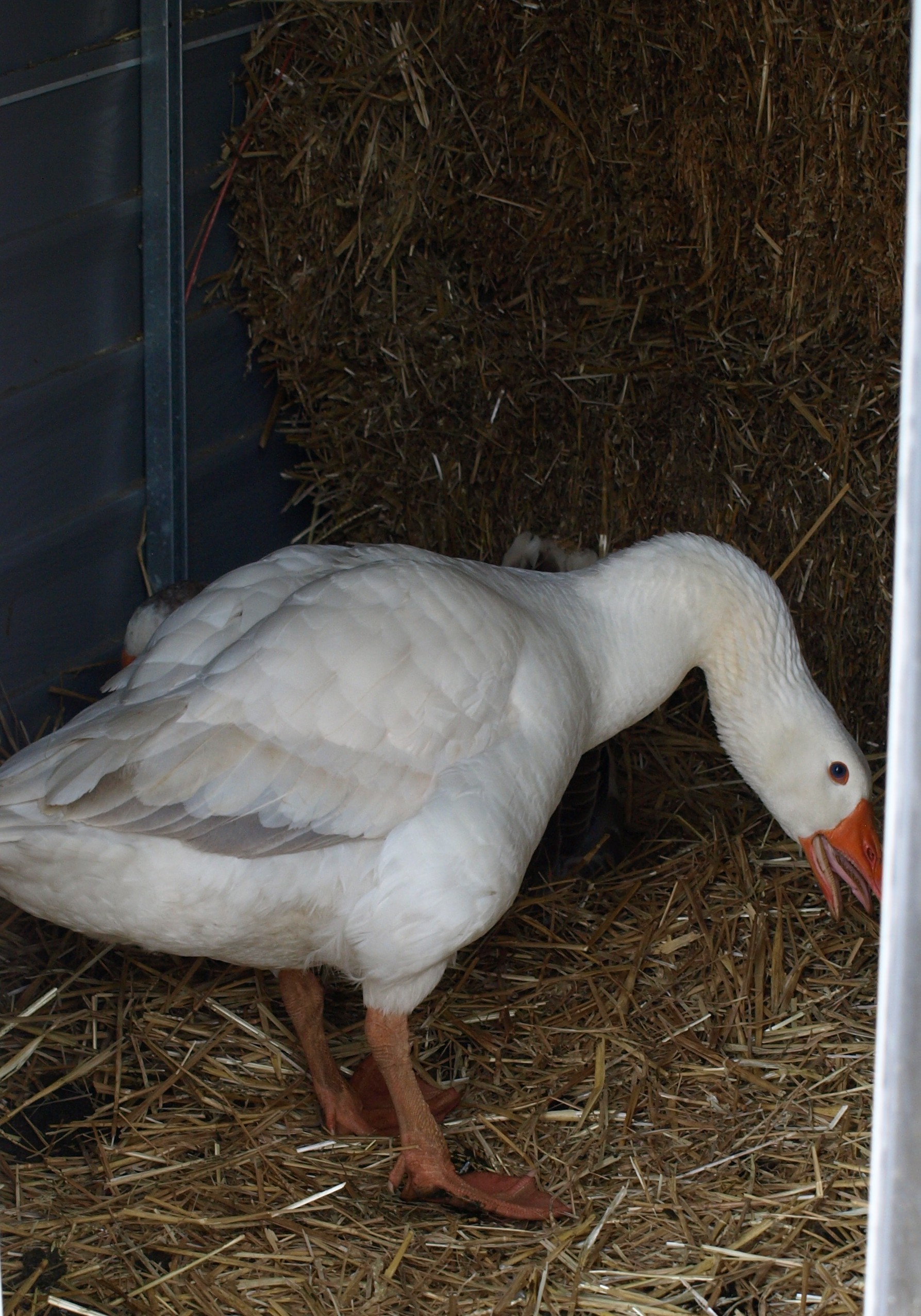
Goose Pail Tales: a goose’s gotta dibble

Living in an older home, on land that has been ranched, farmed and subdivided since the very early 18oos, leads to some interesting finds.

Digging for gardens, or even just the rainstorms we get, can bring many interesting items to the surface.  Pocket knives, old bottles and tools, items thrown into the burn pile that wouldn’t burn, and more.  There are tales of Indian arrowheads to be found everywhere here in Alabama, and that should not be surprising as this was once Native Amerindian land.  Though I confess, I have yet to find any of this valuable treasure here on the Farmlet.

What I do find, after the fact, are the items the rain loosens and brings up.  Things my geese will dibble up out of the soil, and like a Raccoon, will take to the water pail and wash.

To my chagrin, these items look dangerous and non-foodworthy.    For your interest, or not 😉 , here are some treasures my geese have collected so far this year…
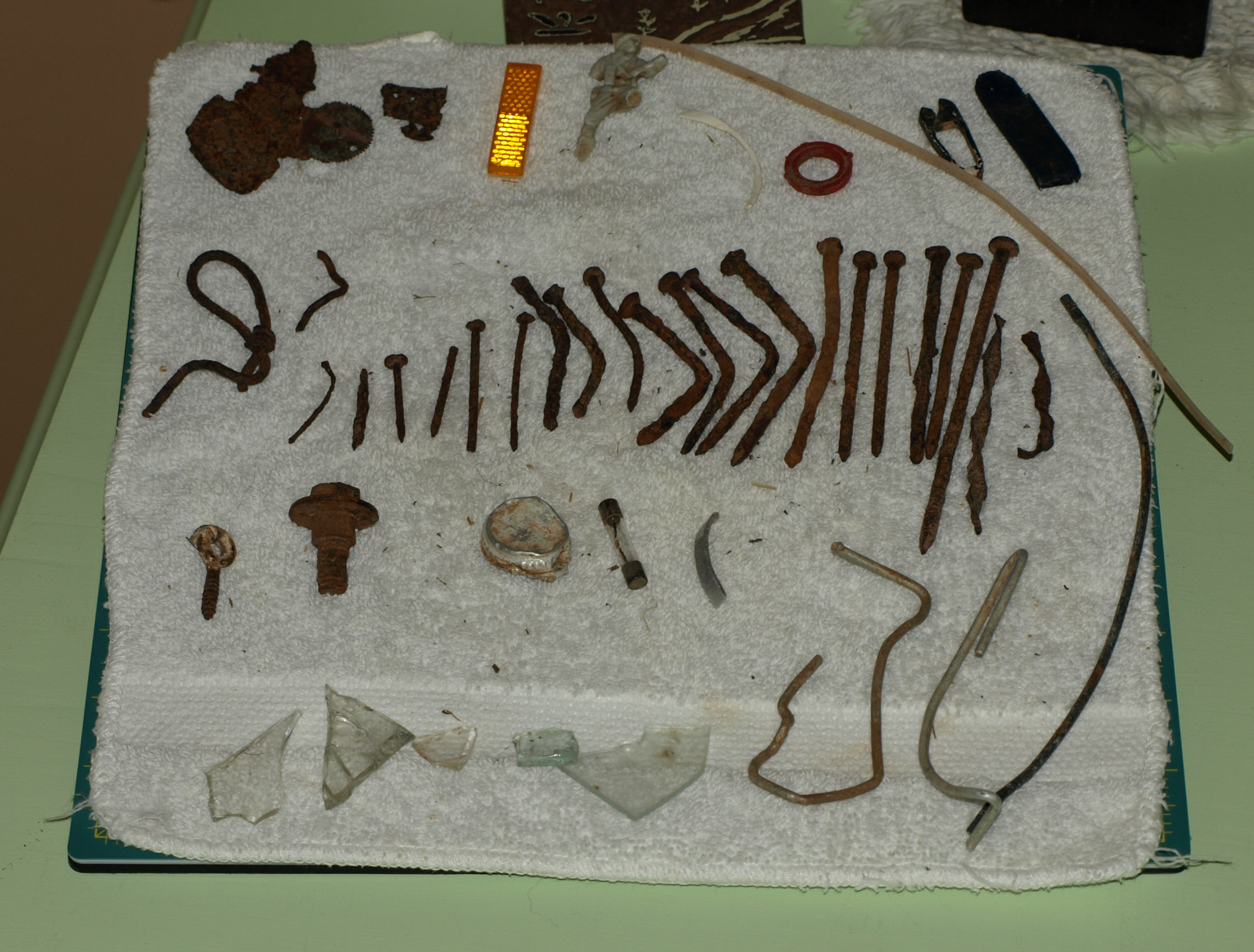
Goose pail trashEach of these items were found at the end of the day when I dumped their water pails!

Row 1, L to R:  rusted clockwork; a 2 in. reflector;  a plastic soldier who’s seen some pretty serious action; an 8 in. plastic zip tie;  a small bit of white plastic; a hose washer; a strange, plastic, locking clip; and a rubberized covering for a tool tip.

Row 2, L to R:  An ancient bit of barbed wire; wire; a row of nails from 1 inch to 5 inches in length;  two bits of *twisted mystery metal; and an underwire from a rather large cupped bra, with plastic coating missing. Eaten?  😛

Row 3, L to R:  An eye screw with a bit of wire attached; a bolt with nut and washer rusted in place; an aluminum screw cap; a fuse from an automobile; a rather sharp piece of heavy gauge, cut aluminum; two miscellaneous bits of twisted, aluminum wire; and …

Row 4, L to R:  Various pieces of glass from broken windows and old glass bottles!  I find this everywhere on the property!  I don’t know why we’re all not missing toes!  Scary.

When I see the items the geese leave behind in their water, I often wonder how much of it I don’t see.  That is to say, how much is small enough to be EATEN!

When I prepare my chickens for the table I have seen bits of glass they swallowed whole, usually pea sized or smaller.  Thankfully, their crops and the rocks they swallow work the edges off the glass shards and apparently with no harm to the bird.  But then I have to wonder…

What have the geese swallowed?

I haven’t a clue.  I can only assume that if any items were swallowed, they  were nothing deleterious to their health!

It is going to rain again today and tomorrow

~*~*~*~

*INTERESTING:  I went looking for barbed wire history, and found this display:
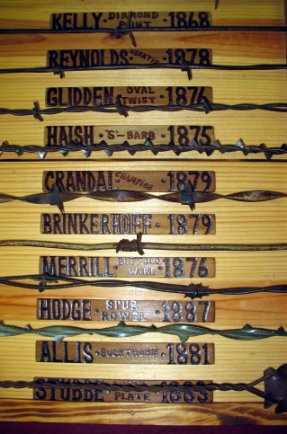
Barbed wire 2(Available for sale HERE)

I may have a bit of antique Crandal ‘Champion’ ca. 1879, or Hodge ‘Spur Rowel’  (sp?) ca. 1887.  Neither of them collectible in their rusted state, but a fun find! 

~*~*~*~

Hm,  if I train them right, maybe they’ll find something really good and I’ll get rich!

!!!

This and that.

The application for the mortgage is in.  Now we wait.

The chickens are back to laying again! 

Fresh eggs anyone?

(!!!)

Late last week it got down to about 23 degrees overnight.  It has taken me five years of living here to figure out to fill the water buckets the night before, and then just break the ice the next morning!  WAY easier than hauling three gallon water buckets from the bathroom out to the goose run.

Recently, my friend Lori of Day by Day the Farm Girl Way wrote a post about how water freezes and its delicate nature  HERE

Well, there is certainly nothing delicate about these 3 x 3 inch quite pointy formations, now is there?  😉

OLYMPUS DIGITAL CAMERA

How did that happen? 

~*~

Polly has a secret.  Shhh…

OLYMPUS DIGITAL CAMERA

And Frellnick is a very overprotective father to be!

OLYMPUS DIGITAL CAMERA

He looks so threatening, doesn’t he?  But he is all show with me.  Georgie on the other hand has been getting his ‘tail feathers’ whupped this past week. 

Sadly, I have had to separate them again.  😦

~*~

In the meantime, I have finally calmed down from the excitement of new Farmlet buying.    So now I wait for a house appraisal, thoroughly CLEAN the aforementioned house in preparation for a very special visitor (who flies in for a weeks stay next month) and watch for Polly to begin setting in earnest!

So much is happening over the next four weeks! 

Don’t you agree?


Fun while it lasted!

This morning, for an hour, it snowed with abandon…

(Please click the first photo to view in a carousel)


By the way, Frellnick and Polly are now inseparable, and doesn’t Frellnick look  proud?  I guess their little honeymoon in the back yard did the trick… 

He doesn’t take any guff off of Georgie now! 

 ***

*Fall is Not Easy: a colorful view of the farmlet

Here on the Farmlet it seems that every fall, just when we start getting some great color, the wind comes and takes it all away.  This fall was no exception and to make matters worse I find myself lame and on a walking stick.  And for those who are wondering, “YES, I am going to the Dr. tomorrow because it has been a week and I am not improving.”

However, wind and lame knee aside, I decided I would give it my best shot and get out to see if I could capture what remains!

Lil’ Bit tiptoeing through the wet leaves.

A festive chicken yard

The newly revamped front flower bed. 

NOTE:  It used to be harder to find native plants, shrubs, and perennials, but all of a sudden the deep South is “getting it.”  I am back in my element!  Not all is native, but the bulk of it will be when I am done!

*Winged Sumac 

This is something I have wanted in my garden for some time, but had not found a local source for it.  I don’t know how it got here perhaps a bird, or the tornado storm, but it is definitely a welcome native.  Do you know why she is called “winged?”

Notes from the USDA Native Plants Database:  “Sumac serves primarily as a winter emergency food for wildlife. Ring-necked pheasant, bobwhite quail, wild turkey, and about 300 species of songbirds include sumac fruit in their diet. It is also known to be important only in the winter diets of ruffed grouse and the sharp-tailed grouse. Fox squirrels and cottontail rabbits eat the sumac bark. White-tail deer like the fruit and stems.
Sumac also makes good ornamental plantings and hedges because of the brilliant red fall foliage.

One burnished tree. 

This one can be viewed closer by clicking on it.  😉

~*~

Happy Autumn!

~*~

(I had fun, even if the results are less than spectacular!)

NOTES: 

  • Today’s title “Fall is Not Easy”  comes from a favorite children’s book I used to share with my little students during the season.  If you have little ones Pre-K to 3rd grades (+ or -)  then perhaps you would like to preview this entertaining book.  Look HERE
  • Why is Winged Sumac ‘winged?’  Have a look at the USDA Plant database PDF – HERE  and the site information HERE